
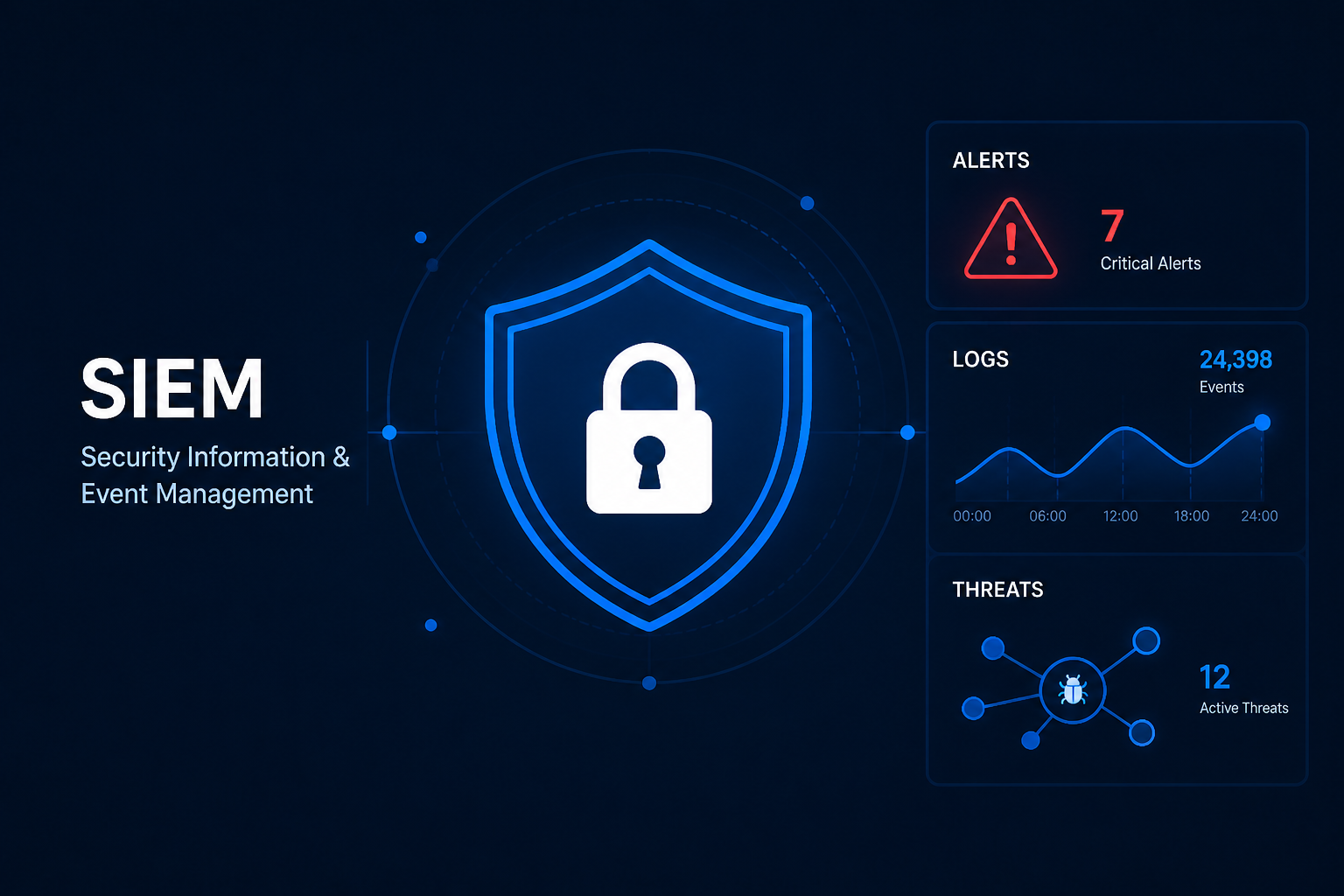
Guide to Security Information and Event Management (SIEM) in 2026
SIEM (Security Information and Event Management) is a cybersecurity solution that collects and analyzes security data from across an organization’s entire IT environment. Its purpose is to detect, investigate, and respond to threats in real time. In essence, SIEM acts as a centralized security intelligence system, gathering logs from servers, networks, firewalls, applications, and cloud platforms, then applying advanced analytics to identify unusual patterns that may signal a cyberattack.
SIEM integrates two foundational components:
- SIM (Security Information Management): Focuses on long-term storage and analysis of log data.
- SEM (Security Event Management): Enables real-time monitoring and correlation of security events.
How SIEM Works: The 4 Core Functions
SIEM software operates through four primary functions:
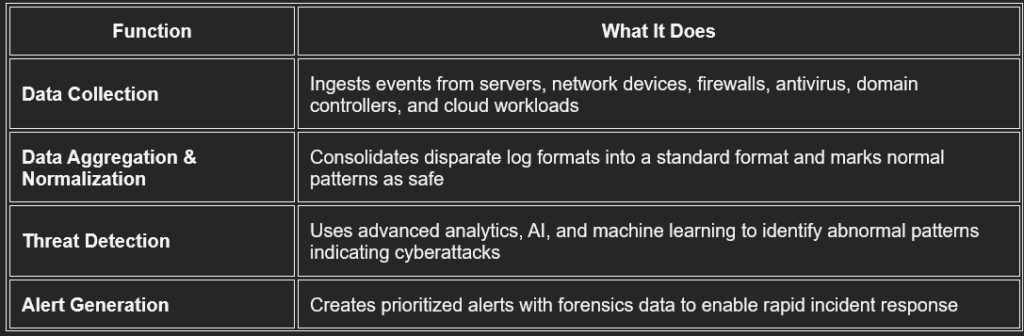
For example, if a user normally logs in once every 10 minutes but suddenly attempts 100 logins in seconds, SIEM flags this as a potential brute force attack.
Key Benefits of SIEM
- Real-time detection: Reduces Mean Time to Detect (MTTD) by automating threat identification.
- Centralized visibility: Provides a unified dashboard for monitoring activity and managing alerts.
- Compliance support: Simplifies log management for standards such as PCI-DSS, HIPAA, and GDPR.
- Advanced analytics: Incorporates capabilities like User and Entity Behavior Analytics (UEBA) to identify insider threats and compromised accounts.
- Broad threat coverage: Detects attacks such as brute force attempts, phishing, cloud-based threats, and unauthorized system changes.
Leading SIEM tools in 2026
- Splunk: Suited for large enterprises requiring advanced analytics.
- Exabeam: Specializes in UEBA (User and Entity Behavior Analytics)-driven threat detection.
- Cortex XSIAM: Focuses on AI-powered automation.
- IBM QRadar: Known for strong compliance and enterprise capabilities.
- Datadog Cloud SIEM: Designed for cloud-native environments.
Best practices for implementing SIEM
- Define security objectives and identify critical assets early.
- Integrate as many relevant data sources as possible into a centralized system.
- Establish incident response workflows, as alerts alone are insufficient.
- Regularly test detection scenarios and review system configurations.
- Continuously fine-tune rules to minimize false positives.
Why SIEM is important
SIEM is especially valuable for large organizations, cloud-centric environments, compliance-focused industries, and teams with limited security resources. It reduces manual effort and speeds up incident response.
Deployment options
- On-premises: Hosted within the organization’s infrastructure.
- Cloud-based: Offers scalability and flexibility.
- Hybrid: Combines on-premises and cloud deployment.
When selecting a SIEM solution, consider factors such as organizational size, cloud strategy, compliance requirements, and existing security tools.
Bottom line
SIEM delivers the visibility and automation required to protect sensitive data across complex, hybrid environments. The key decision is not whether to adopt SIEM, but which solution aligns best with your organization’s needs.
Please feel free to connect with our cyber security services personnel for SIEM consultation and implementation.