Microsoft Patch Tuesday June 2026

Microsoft’s June 2026 Patch Tuesday, delivered on June 9, 2026, is one of the most impactful security updates in recent years. It patches roughly 200 vulnerabilities, including three zero-day flaws, underscoring how enterprise security is becoming more complex and why fast patching is now essential.

Breakdown of vulnerability types

The June release spans many vulnerability categories:

  • Elevation of Privilege (EoP): ~65
  • Remote Code Execution (RCE): ~55
  • Information Disclosure: ~30
  • Security Feature Bypass: ~19
  • Denial of Service (DoS): ~7
  • Spoofing: ~27

RCE and EoP flaws are the most common, and attackers often chain them together to achieve full system compromise.

Zero-day vulnerabilities

This month includes three publicly disclosed zero-day vulnerabilities (none were confirmed as actively exploited at release):

  • CVE-2026-45586 – Windows CTFMON elevation of privilege.
  • CVE-2026-49160 – Windows HTTP.sys denial of service.
  • CVE-2026-50507 – BitLocker security feature bypass.

Because these issues are publicly disclosed, they’re more likely to be weaponized quickly.

High-priority critical vulnerabilities

Several critical flaws require immediate attention due to their severity and exploitability.

Remote Code Execution (RCE)

CVE-2026-47291 (HTTP.sys) – CVSS 9.8

Unauthenticated RCE

Potentially wormable (no user interaction required)

CVE-2026-44815 (DHCP Client) – CVSS 9.8

  • Affects nearly all Windows endpoints.
  • Very large attack surface.

Other key targets

  • Remote Desktop Client (multiple RCE flaws).
  • Windows Hyper-V (VM escape risks).
  • Active Directory and Kerberos services.
  • Microsoft Office (malicious document attacks).

Affected systems and services

This Patch Tuesday touches nearly every layer of Microsoft’s ecosystem:

  • Operating systems: Windows 10, Windows 11.
  • Enterprise infrastructure: Active Directory, Hyper-V, DNS.
  • Cloud and dev: Azure, Azure Kubernetes Service (AKS), Visual Studio Code.
  • User applications: Office, Outlook, Word.
  • Security and identity: BitLocker, Kerberos, Defender.
  • Emerging platforms: Copilot and AI integrations.

The wide scope confirms this isn’t just a desktop patch cycle—it’s a full-stack security event.

What IT teams should do

Immediate actions

  • Prioritize critical RCE vulnerabilities (HTTP.sys, DHCP Client).
  • Patch internet-facing systems first.

Deploy updates across:

  • Domain controllers.
  • Remote Desktop environments.
  • Cloud workloads.

Short-term strategy

  • Test patches in staging before full rollout.
  • Monitor for exploit attempts, especially against zero-days.
  • Update endpoint detection and SIEM rules.

Long-term improvements

  • Implement risk-based vulnerability management (RBVM).
  • Reduce the exposed attack surface.
  • Strengthen identity and privilege management.

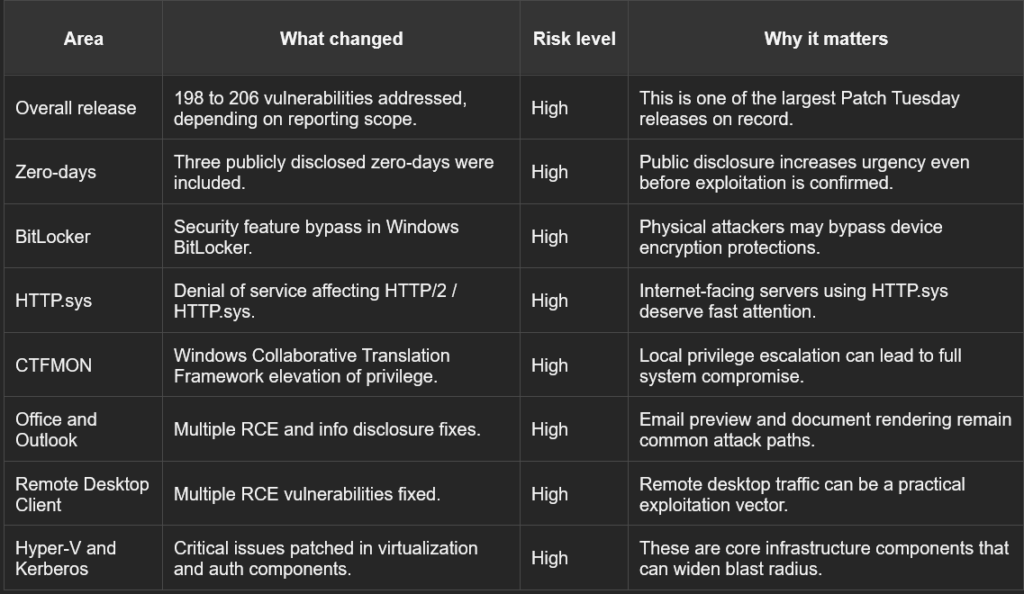
Summary table

What to prioritize

Begin with internet-facing servers, especially those running HTTP.sys, Remote Desktop, Exchange, SharePoint, or Hyper-V. Then move to privileged endpoints and laptops, since BitLocker bypasses and local elevation flaws are especially dangerous when an attacker already has physical or local access.

For enterprises, the usual rollout order should be perimeter servers, admin systems, critical collaboration platforms, and then broad endpoint deployment. If your organization relies heavily on Microsoft technologies, this month is also a good reminder to include developer tools and cloud-adjacent services in vulnerability management, not just Windows desktops.

Closing thoughts

June 2026 shows that Patch Tuesday is now more than a Windows desktop update cycle. It is a cross-platform security event that affects endpoints, servers, cloud services, and productivity software at the same time. The right response is simple: patch quickly, start with the highest-risk systems, and move fast when vulnerabilities are publicly disclosed.

At Dual Layer managed IT services, we have developed automated patching plans to suit the client needs. Connect with us to learn more about software updates patching practices.

Cyber Security
Cloud Computing Services