
Microsoft’s September 2026 Patch Tuesday is set to be one of the largest security update releases in the company’s history. Addressing nearly 1,000 vulnerabilities across Windows, Office, Exchange Server, SQL Server, SharePoint, Azure services, and other products, this release underscores both the accelerating pace of vulnerability discovery and the critical need for proactive patch management.
A Record-Breaking Release
Depending on the methodology used by security researchers and vendors, Microsoft patched between 966 and 974 vulnerabilities in September 2026—far exceeding previous Patch Tuesday records and more than doubling the count from August 2026. Analysts suggest part of this surge stems from Microsoft’s increased use of AI-driven tools to identify software weaknesses more rapidly.
Vulnerability Breakdown
The September update included:
- 438 Elevation of Privilege (EoP) flaws
- 258 Remote Code Execution (RCE) issues
- 173 Information Disclosure bugs
- 56 Denial of Service (DoS) defects
- 19 Security Feature Bypass problems
- 16 Spoofing vulnerabilities
Over 100 of these were rated Critical, many allowing remote code execution without user interaction.
Two Actively Exploited Zero-Days
The most urgent fixes addressed two zero-day vulnerabilities already being exploited in the wild:
CVE-2026-81963 – Windows Update Stack EoP: This flaw involves improper link resolution during file operations. Local attackers could exploit it to gain SYSTEM-level privileges, effectively taking full control of the machine. Microsoft confirmed active exploitation but has not released detailed attack information.
CVE-2026-85880 – Windows ALPC EoP: This vulnerability is a heap-based buffer overflow in the Advanced Local Procedure Call (ALPC) subsystem. Successful exploitation enables privilege escalation to SYSTEM level, allowing attackers to escape restricted environments.
Given confirmed exploitation, organizations should prioritize deploying these patches immediately.
Other High-Risk Critical Flaws
Beyond the zero-days, several critical vulnerabilities demand urgent attention:
CVE-2026-69730 – A Windows DNS Server RCE flaw with a CVSS score of 9.8. Since DNS servers often run on domain controllers, exploitation could grant attackers direct access to core enterprise infrastructure.
Additional unauthenticated RCE vulnerabilities were found in:
- DNS
- DHCP
- Microsoft Message Queuing (MSMQ)
- Network File System (NFS)
- Secure Socket Tunneling Protocol (SSTP)
These services are commonly exposed in enterprise networks, heightening the urgency for remediation.
Products Most Affected
The September release impacted a wide range of Microsoft technologies. According to security reports, the largest vulnerability counts affected:
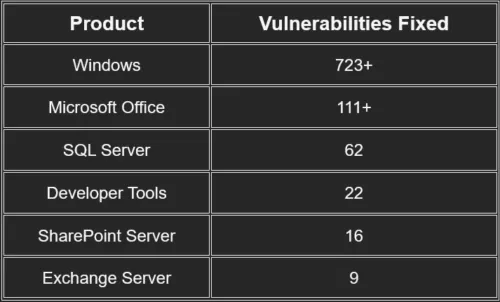
Organizations running hybrid environments should ensure that server workloads receive equal attention alongside endpoint devices.
Windows 11 Quality and Feature Updates
Alongside security fixes, Microsoft delivered quality and feature improvements for Windows 11 versions 24H2, 25H2, and 26H1, including:
- Expanded taskbar customization.
- Faster Windows Search performance.
- More Start Menu personalization options.
- Touch-friendly File Explorer enhancements.
- Stability fixes for Microsoft Teams and Outlook on Arm64 devices.
These updates improve usability while reinforcing security.
Recommendations for IT Teams
Given the scale of fixes and active exploitation of certain flaws, IT administrators should:
- Prioritize patches for the two zero-day vulnerabilities.
- Immediately update internet-facing servers.
- Focus on DNS, Exchange, SharePoint, and Remote Desktop infrastructure.
- Accelerate application compatibility testing.
- Monitor post-deployment performance and security logs.
- Ensure Servicing Stack Updates are applied where relevant.
Final Thoughts
September 2026 highlights how quickly the security landscape is evolving. With close to 1,000 vulnerabilities patched—including multiple actively exploited flaws—this Patch Tuesday reinforces that timely patch management remains one of the most effective cybersecurity defenses.
Delaying updates leaves organizations exposed to threats already in use by attackers. As AI-assisted research accelerates vulnerability discovery, maintaining a disciplined, risk-based patching strategy is more critical than ever.
At Dual Layer managed IT services, we have developed automated patching plans to suit the client needs. Connect with us to learn more about software updates patching practices.